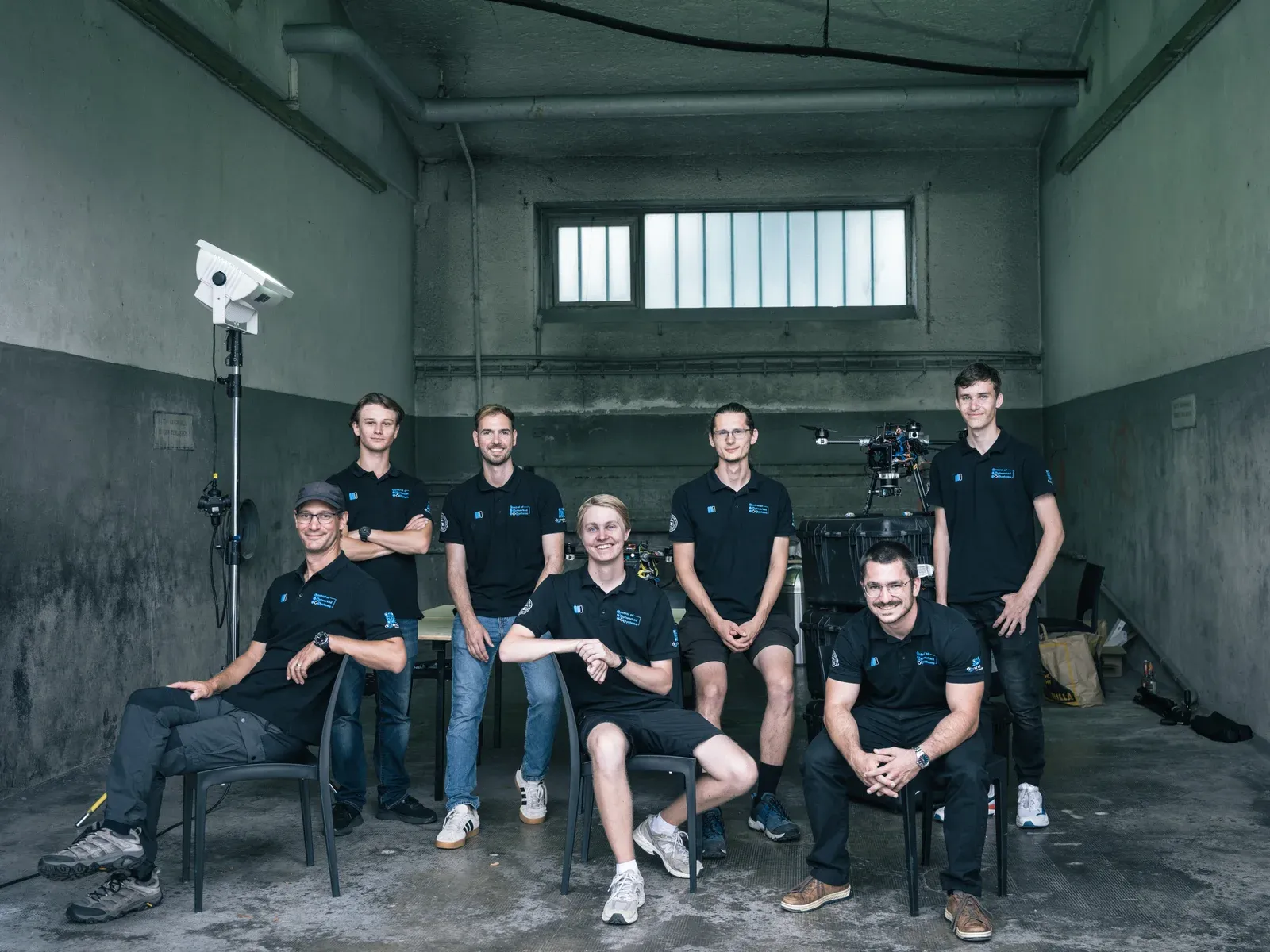
The HERMES team from the Control of Networked Systems (CNS) group at the University of Klagenfurt won Stage 2 of SPRIN-D’s Fully Autonomous Flight 2.0 Challenge. The final took place at Erding Air Base in late August 2026. Our CEO Luca Di Pierno led the student team over two years and designed the system’s core autonomy and overall navigation architecture.
The challenge
Organised by Germany’s Federal Agency for Breakthrough Innovation, the programme asked teams to develop complete autonomous aerial systems for environments they had not encountered before. It tested how perception, navigation, reasoning and mission execution worked together, with applications including logistics, search and rescue, and infrastructure inspection. Fourteen teams were initially selected, and seven advanced to the final after a mid-term evaluation.
The aircraft had to operate without Global Navigation Satellite System (GNSS) positioning, prepared maps, cloud connectivity or a remote pilot directing the mission. Teams had approximately 30 minutes to inspect the environment before each mission and 60 minutes to complete the assigned tasks. The exact objectives were communicated shortly before take-off through a chat interface. The software therefore had to interpret the mission, assess its surroundings, plan its actions and adapt during execution, on board and in real time.
Conditions varied throughout the competition, from rain at around 17°C to bright sunshine. Changes in lighting and differences between feature-rich areas and locations with little texture or geometric structure placed additional demands on onboard perception and state estimation. The aircraft had to maintain localisation while updating its understanding of the scene and adjusting its behaviour as new information became available.
Autonomous mission execution
The missions combined several capabilities within the same flight. Depending on the task, the UAVs had to:
- Navigate through unfamiliar environments without satellite positioning.
- Interpret their surroundings and search for relevant objects.
- Deliver payloads to the specified destination.
- Locate and track people during search-and-rescue scenarios.
- Coordinate multiple aircraft and adapt as conditions changed.
These tasks required perception, state estimation, semantic scene understanding, planning and decision making to operate as one system. HERMES demonstrated this integration in the final, including simultaneous operation of two aircraft. The tracking mission shown in the video below illustrates how the system followed a moving person while planning its own route around obstacles.
The HERMES architecture
The winning system was built around a modular autonomy architecture designed by Luca Di Pierno and developed with the student team over more than two years. Its components combined navigation and autonomous flight with scene understanding, planning and mission-level decisions. This allowed the aircraft to revise its behaviour during a mission as its observations changed.
The architecture was designed for use beyond a single competition. Clear interfaces, reusable components and abstractions independent of the aircraft hardware allowed individual capabilities to evolve while remaining part of an integrated system. The competition tested those design decisions alongside hardware integration, system testing and flight operations.
From HERMES to Vasco Robotics
The autonomy and navigation technology developed for HERMES forms the technical foundation of Vasco Robotics. We are building on this work to develop autonomy software that combines perception, resilient state estimation, semantic understanding, planning and decision making across different aircraft and missions.
Our approach centres on modularity, adaptability and verifiability. Capabilities should be able to evolve independently, operate across different hardware platforms and respond to changing conditions. We treat verifiability as an architectural requirement, with explicit behaviour and clear interfaces that support testing and formal analysis. The aim is to support both individual aircraft and coordinated systems without rebuilding the software for every deployment.
UAVs are our current focus. The longer-term direction is software that can extend to other autonomous robotic systems operating in complex environments. Changes in weather, lighting, sensor reliability and mission objectives are part of the conditions that this software must address.
Acknowledgements
We thank the students, researchers and supervisors at the Control of Networked Systems group who contributed to software development, hardware integration, system testing and flight operations. Particular thanks go to Prof. Stephan Weiss for his continued guidance, trust and support throughout the project.
We also thank SPRIN-D for organising the programme and providing an opportunity to evaluate autonomous systems under competition conditions. The result reflects the combined work of the team and the support of everyone involved throughout the project.
Further reading
More information is available on the official challenge page, in SPRIN-D’s report on the final, and in the University of Klagenfurt’s report on HERMES.
Photos and video
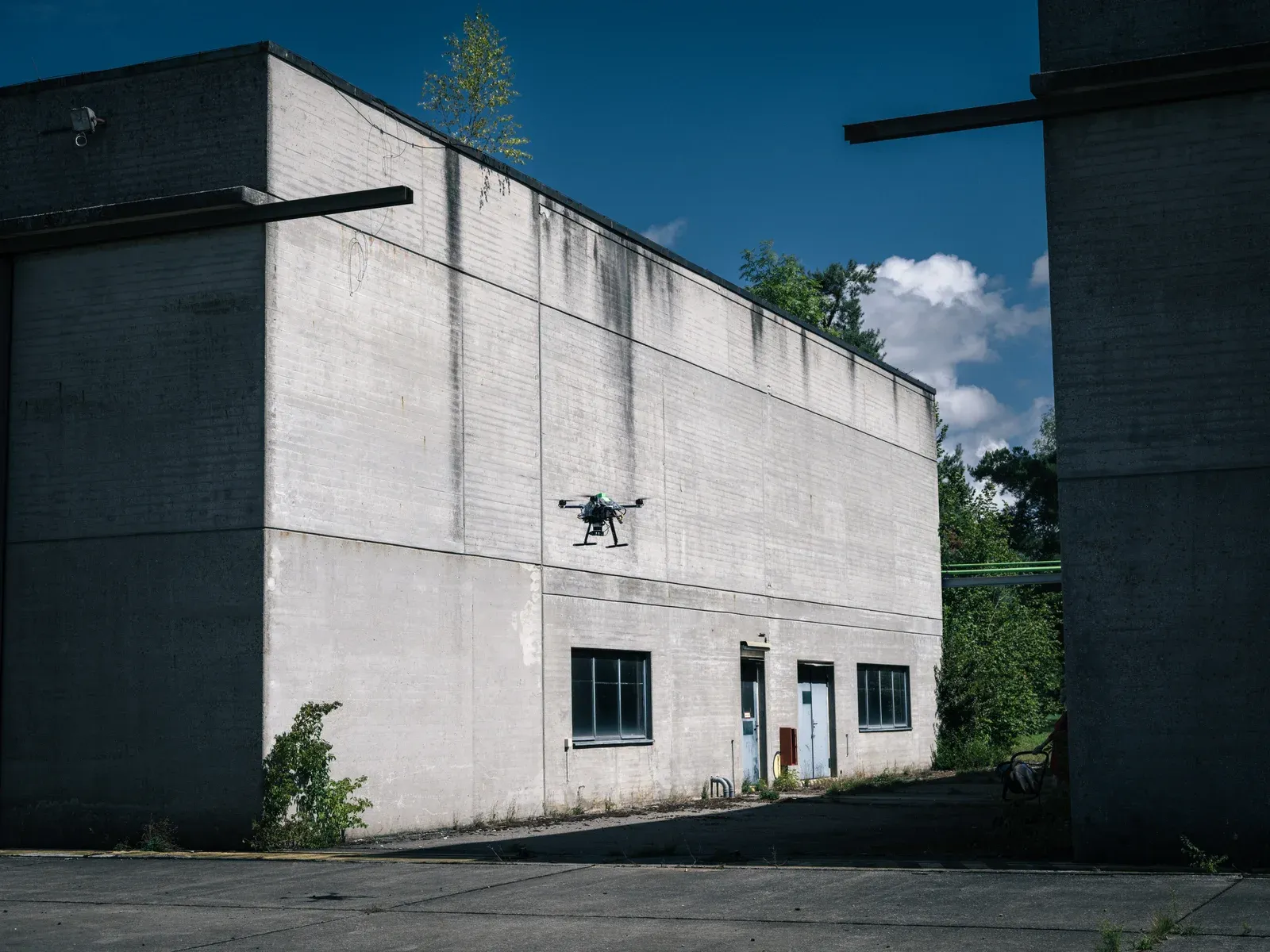
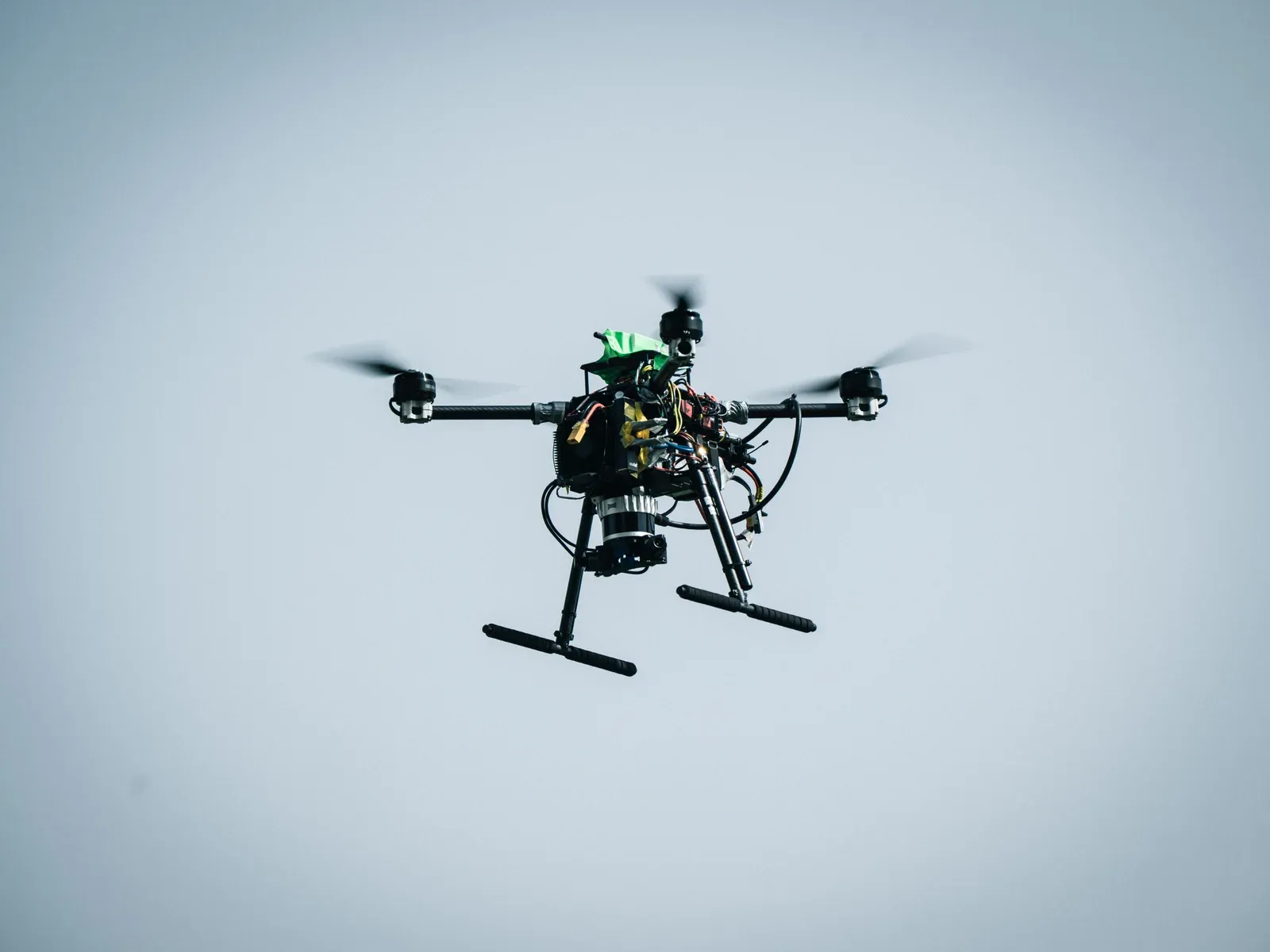
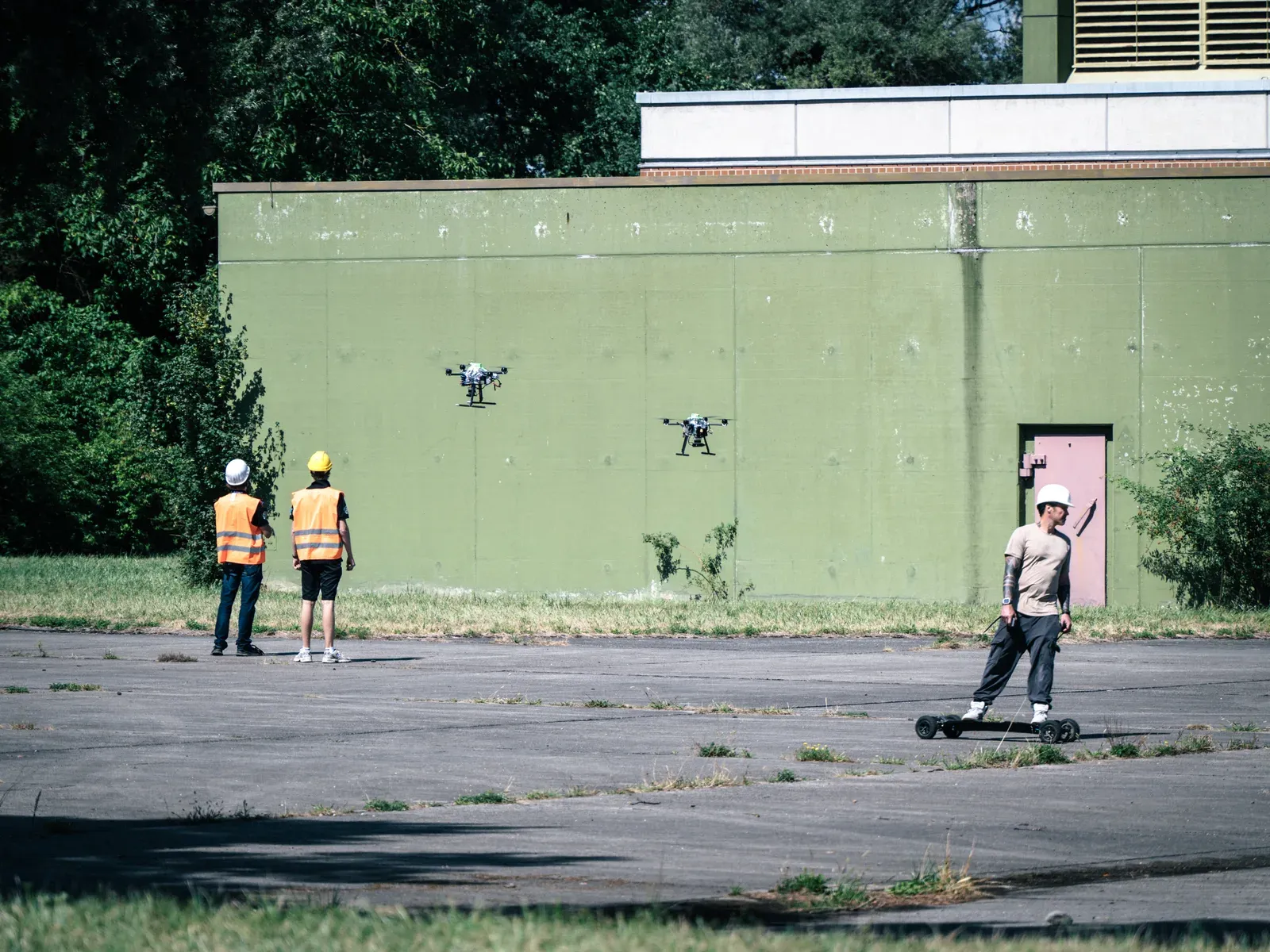
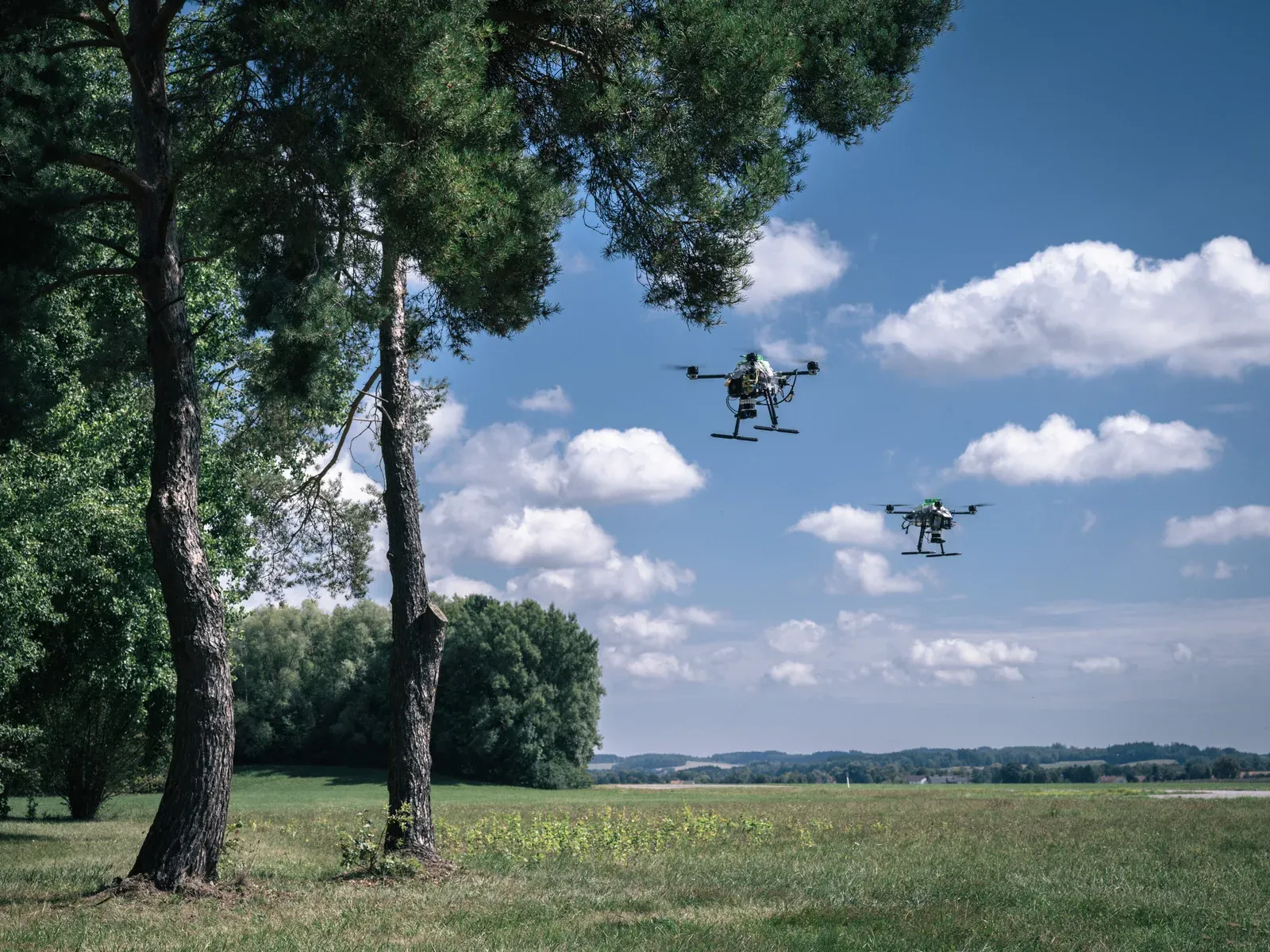
Task 4: tracking a moving person
Task 4 was the dynamic search-and-rescue mission and the hardest of the final. The aircraft had to find and then follow a person for ten minutes across an unknown area without GNSS, identifying them only by a distinguishing physical feature. The teams were not told what the person would do.
In the final, the target walked, ran, got on a bicycle, set off smoke flares and finally hid under an umbrella. The aircraft had to keep them in view through trees, between buildings and over rooftops, re-plan its own path around obstacles and decide, on board and in real time, whether a gap was wide enough to fly through. The footage below shows HERMES staying with the target throughout.